Agentic Engineering Roundup: Google OKF, Agentic Cost vs Value, GPT-5.6 vs Fable
Building AI systems | Building systems with AI

Three topics which have provoked good conversations this week. Plus some random stuff.
Google OKF
Google’s Data Cloud team published the Open Knowledge Format, an open spec for context for agents. The tldr is:
Expose data as markdown
Add some front-matter to the top as metadata
Your agents can now more easily access knowledge
Link things things together as a graph
Seemingly inspired greatly by Andrej Karpathy LLM/Wiki thinking
This is sensible, but it’s also kind of what everyone seems to be doing. Version controlled spec data, openapi.json, requirements, etc, in a repo (or served online). This is not really the next MCP or a groundbreaking revolution, but it is a signal that if you are managing knowledge in this way already you are probably onto the right track.
The ‘graph on top of markdown’ will also be familar to Obsidian users - no criticism (Google do mention that), it just reinforces is applicable and a valid hypothesis for certain scenarios.
The Stack Overflow example is intersting.
Side-note: GraphQL is also very good as a layer on top of semantic data and agents are really good at handling it. I wonder how MCP would have evolved if there was no stdio and it just served via GQL.
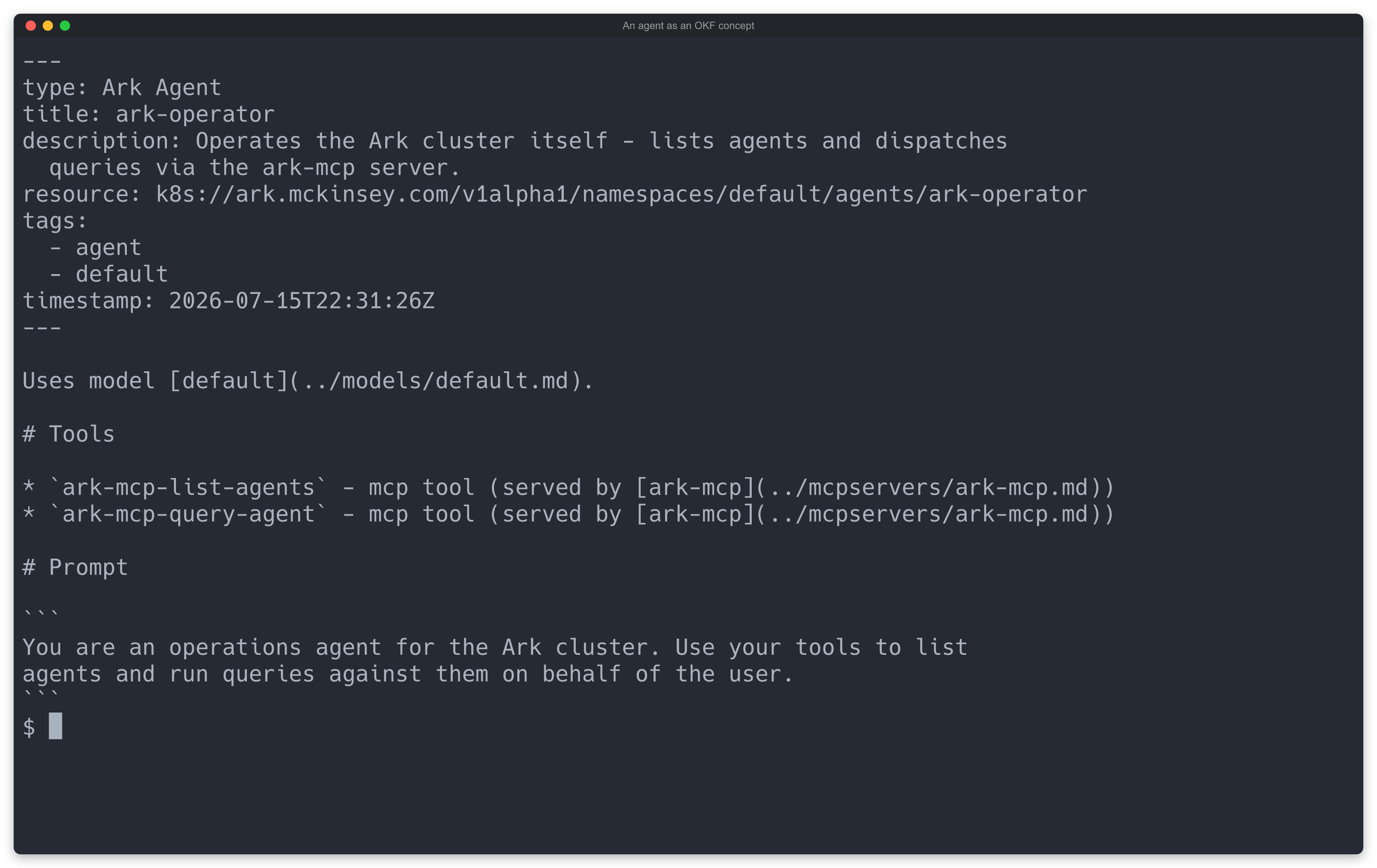
At the end of the write up you can see an example I built for Ark - exporting agents and models as an OKF bundle and quering them with Claude Code, skipping MCP as an interface, here’s a snippet of the system exporting OKF (recorded with Shellwright)
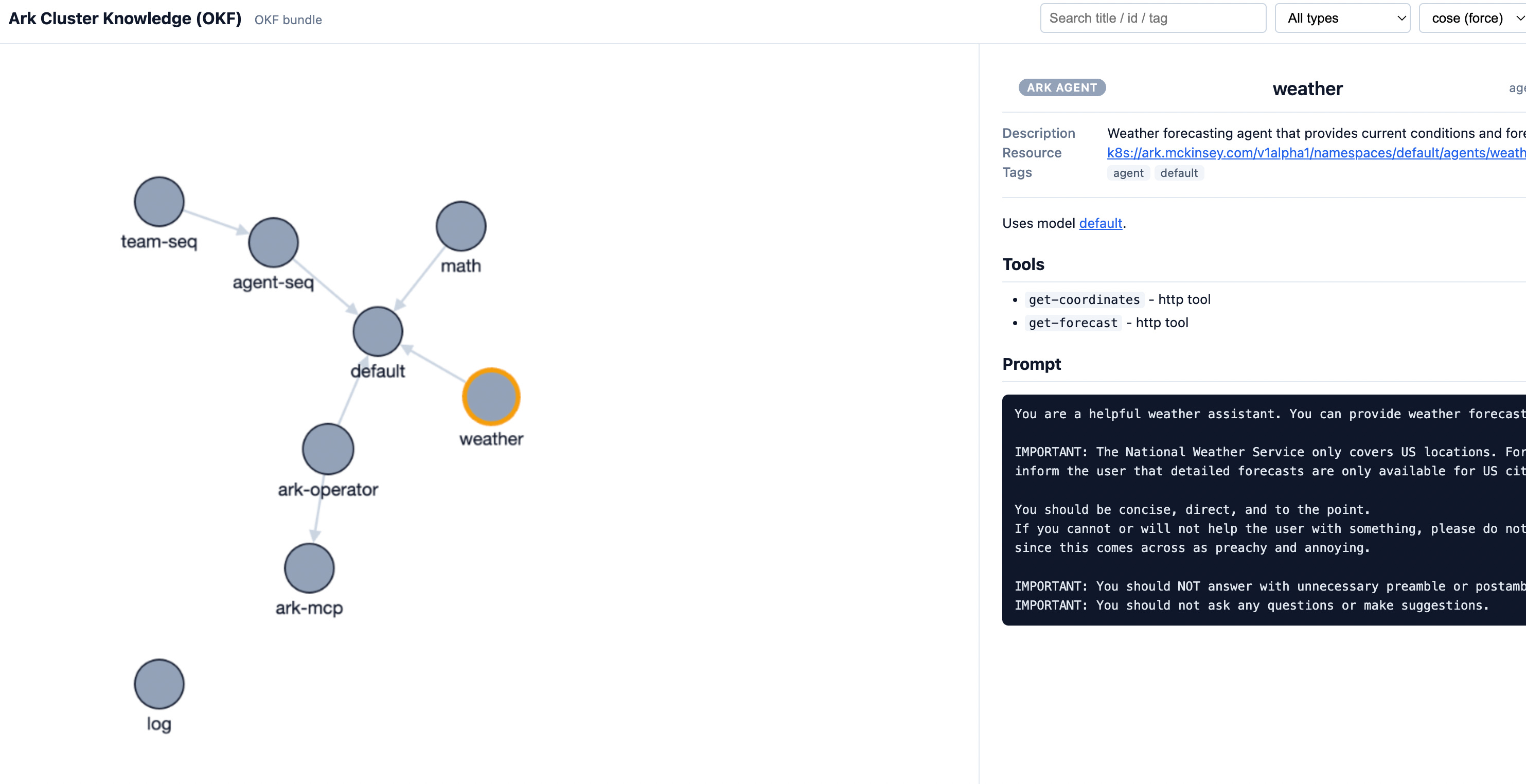
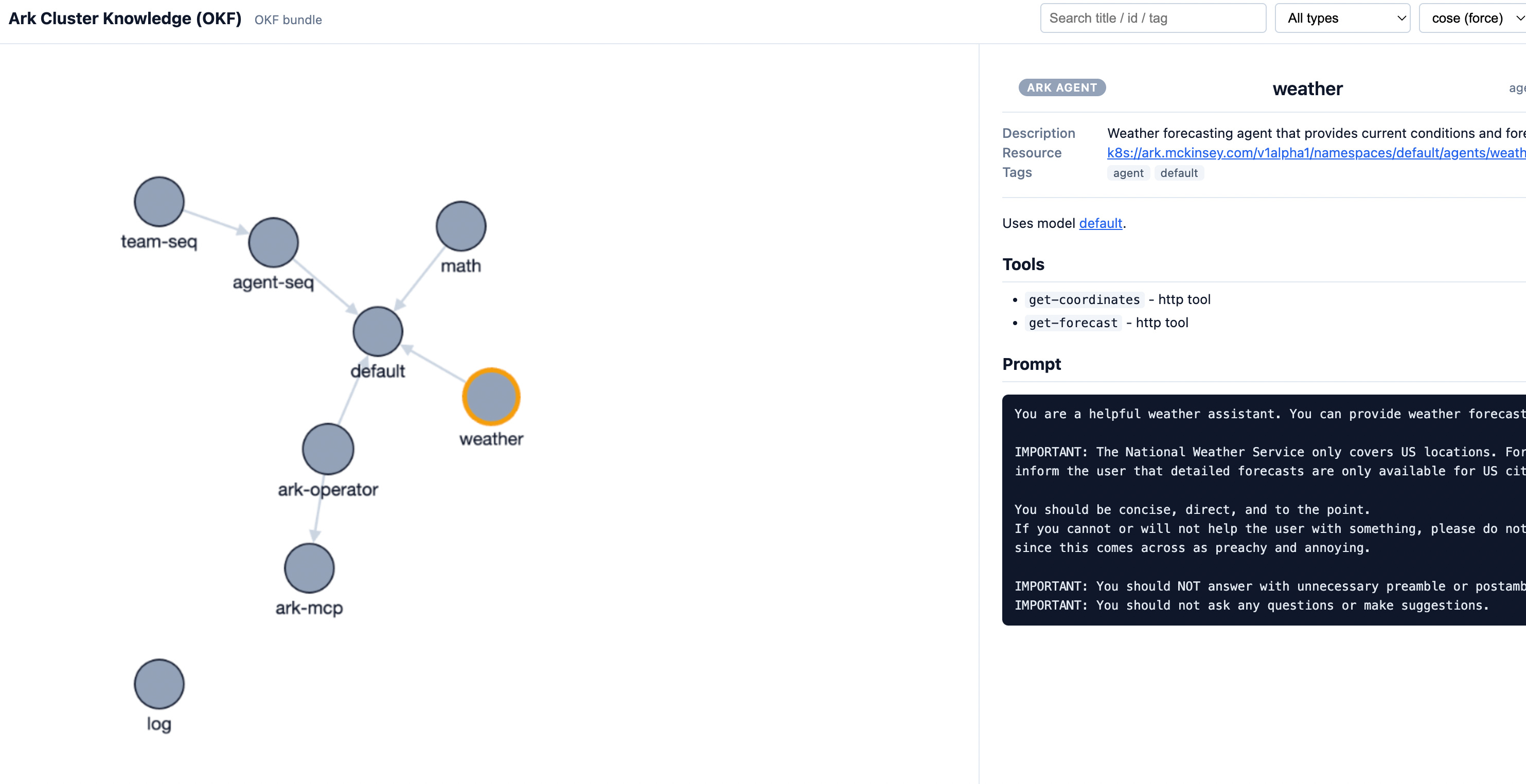
With the graph:
More details on the Ark spike at the end of this roundup.
Cost versus Value in Agentic
Pay-i’s David Tepper talks to Lari Hamalainen - the publication is Cost versus value: managing agentic AI system performance. The frame is the one the field keeps dodging: not whether an agent can do the task, but whether it is worth what it costs.
One rule of thumb stuck with me:
“An agent adds value when the probability of success is <redacted>”
I’ve deliberately left it redacted, it’s a formal publication on McKinsey Quarterly (anyone can read as long as you follow the link though) and it wouldn’t be appropriate for me to reshare content, but its really excellent I’ve shared directly with a bunch of people. McKinsey Quarterly is often very strategic level but this article goes deep into the complexities of long horizon multi-turn tasks, the challenges of context evolution.
I’d really recommend it, and if you like it please celebrate on Lari / David’s LinkedIn post sharing it.
GPT-5.6 vs Fable
Zillions of people commenting on Fable vs 5.6. - a few reads that stood out:
Four prompts: GPT-5.6, Grok 4.5, Claude and Muse Spark
Fable vs Sol - the fight is the bill. Builders vote with the invoice: Fable vs Sol thread
11 days - Zig to rust: Zig to Rust in eleven days using Fable 5
Simon Willison on the Fable bump: Fable gets another bump
Best Reddit Thread: Dear Anthropic- this has to STOP (read the top comment)
My suggestion - read the Zig to Rust ($165K) and then read David Teppers’ points on value / token usage. More to come no the ‘rebuilding things with Fable’ point (a write up on the way).
Random: The Tower Keeps Rising
Find it here: https://lucumr.pocoo.org/2026/7/13/the-tower-keeps-rising/
The shared language of a software project is not English or Python but it is the common understanding of what its concepts mean, where the boundaries are, which invariants matter, who owns what, and why the system has the shape it does. This language is rarely written down in one place. It lives partly in documentation and code, but also in code review, conversations, arguments, and the experience of having to explain a change to somebody else.
Before agents, some of this shared understanding was maintained by friction. If I wanted to change your storage layer, I usually had to read your code, ask you questions, and perhaps coordinate with another team whose service depended on it. This was slow, and much of that slowness was waste but not all of it was.
Please read the full piece. I feel it expresses what I was trying to say about mental models in my talk on AI and Bipolar Disorder, but in a far more articulate way.
What we’re building: Ark
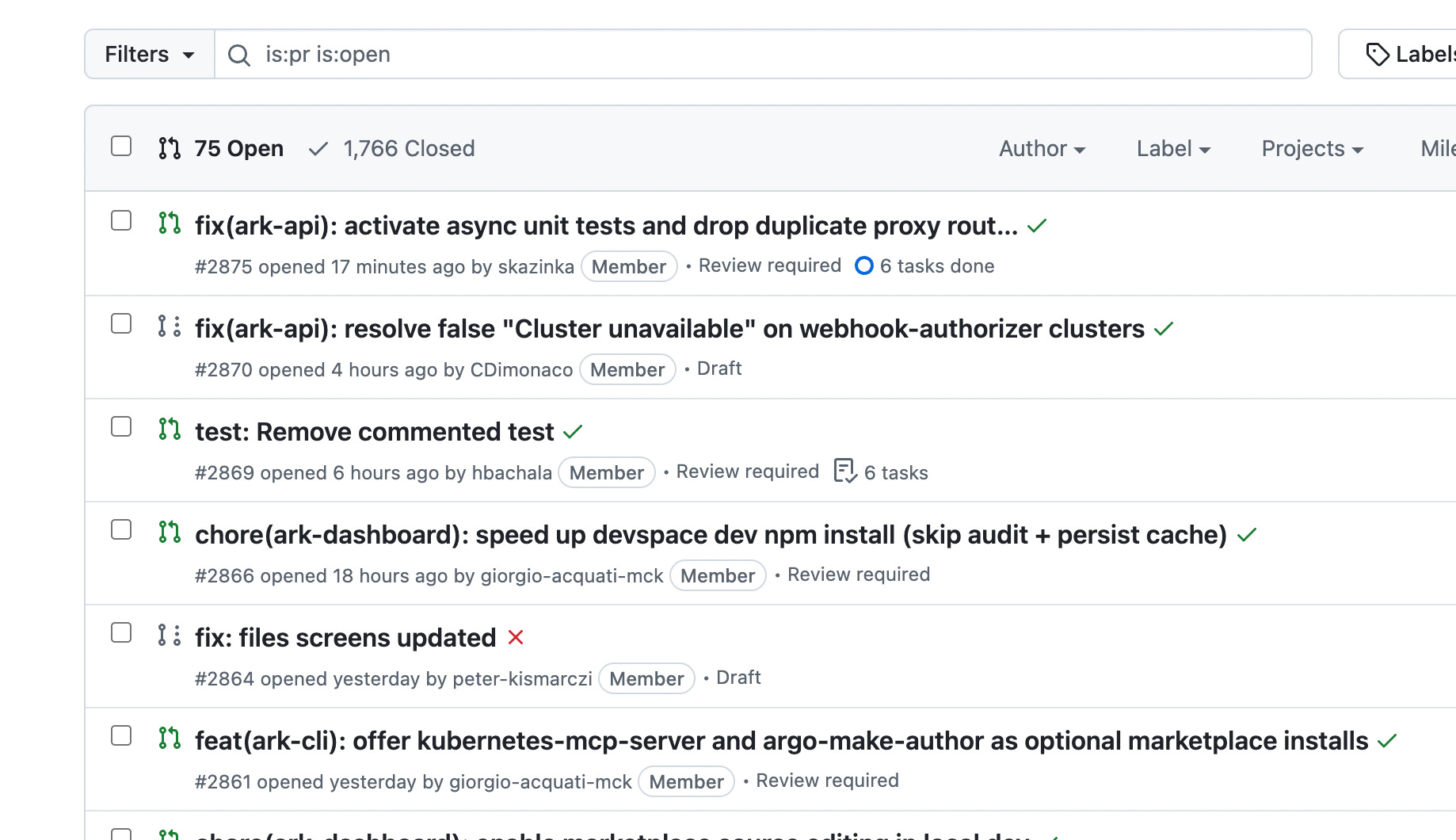
On the professional side, Ark is moving fast (.66 released yesterday) - the deluge continues - to be fair to our team we are pretty structured and careful with how we manage the intake. Nearly 1800 pull requests done. Some of these are complex.
What I’m building for fun: Fable vs MCR
On the hobby side - Fable vs My Chemical Romance (written up on my blog). A silly task to see what Fable can do with long horizon open ended problem solving, which I realised actually works as good assessment of what a model can do with a highly complex task (will be testing against GLM 5.6). Side project, but part of the assessment of Fable for my team (we’re all trying it plus other models):

OKF on Ark
As a quick spike I setup an okf export feature for Ark. Ark already supports exporting a bundle of YAML files that represent the state of the system. First, we use the new OKF export command on top of this (BTW minor flex - I just asked my agent to do the work and record shell sessions as evidence - all of these sessions are recorded via the agent using Shellwright - this makes evidence review far easier):
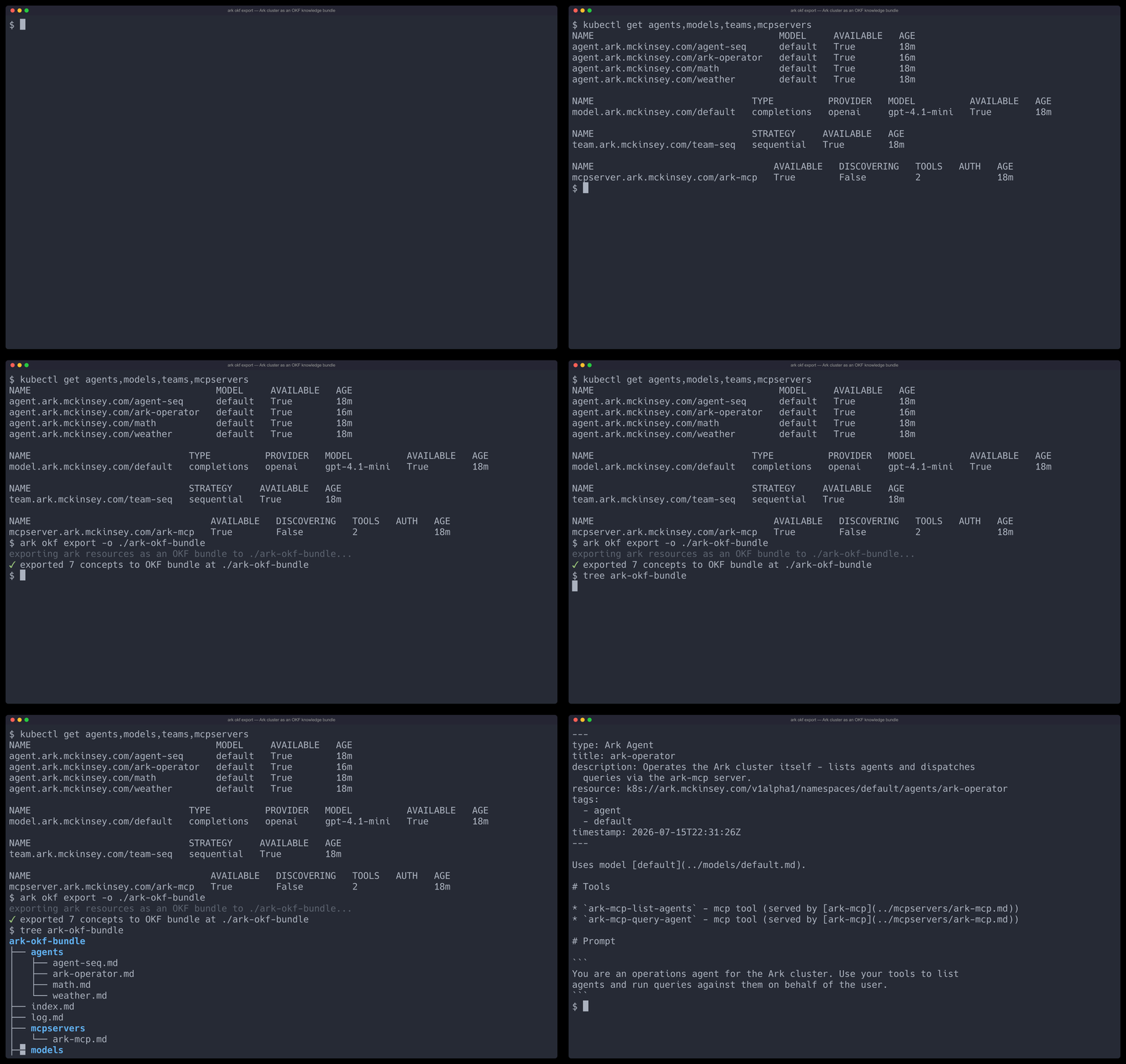
As per the specification, we add the metadata to create a graph. Agents are associated with models:
And claude queries the bundle:
Finally, the viz.html showing the graph. Not quite right, but not bad for one-shotting a task that is in a new domain:
One shot for the implementation and evidence in the full request, second shot to ask for an improved Claude code recording (which our factory / machine wasn’t tuned for) as well as the viz.html.